
Sadler Publications
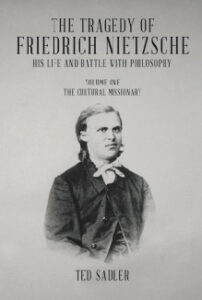
The roots of Nietzsche’s intensely personal philosophy were laid down early in his life. This first volume of The Tragedy of Friedrich Nietzsche covers his childhood, school and student years, and his career at Basel University. His relationship with Richard Wagner is treated in detail. All Nietzsche’s main philosophical writings of the period are analysed.
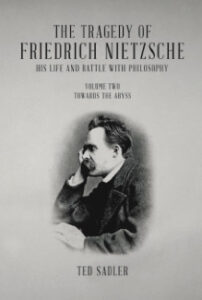
This second volume of Sadler’s comprehensive biography tells the story of the mature Nietzsche, as he wrote the works for which he became famous while propelling himself to his own final cataclysm. The collapse of his relationship with Richard Wagner is narrated, as is the debacle of his liaison with Lou Salomé. All his philosophical works are explained and analysed.
The significance of Nietzsche is not that he developed a new philosophy or destroyed the old idea of philosophy, but that he fought a battle with philosophy in the age of the Death of God. He offered a ‘new gospel’, but this founders on its own contradictions, especially on the idea that philosophy can take the form of anti-philosophy. Nietzsche’s ‘failure’, however, was his achievement and success, because only his passion for philosophy allowed him to fail in such a tragic way, just as it allowed the revelation of philosophy that occurs in his writings.
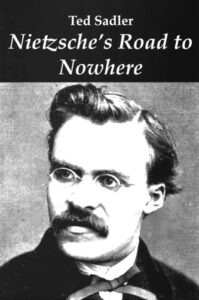
Nietzsche was his whole life a seeker. From his childhood onwards he never stopped looking for a ‘way out’ of the nihilism that arrived in the West with the Death of God. Although he travelled on many false paths and never found what he was looking for, his wayward journey, including its disastrous end, itself illuminates the nature of philosophy as no theorising can do.

The Essence of Truth is a lecture course delivered in 1931-32 at the University of Freiburg, analysing both Plato’s allegory of the cave in The Republic and the central section of his Theaetetus. Heidegger contrasts the metaphysical concept of truth in the Greeks with his own concept, fundamental to his entire philosophy, of truth as the ‘unhiddenness of beings’.

These previously untranslated lectures were delivered by Heidegger at the University of Freiburg in the summer of 1930. They are fundamental for understanding Heidegger’s view of Greek philosophy and its relationship to modern philosophy. In no other work by Heidegger do we find either such a detailed a consideration of Kant’s practical philosophy, or a comparably thorough interpretation of Aristotle’s Metaphysics.

Heidegger is widely regarded as the twentieth century’s most original philosopher. This volume brings together two previously untranslated lecture courses given at Freiburg University in 1919: ‘The Idea of Philosophy and the Problem of Worldview’ and ‘Phenomenology and Transcendental Philosophy of Value’. The third lecture included here, ‘On the Nature of the University and Academic Study’, is a translation of a transcript of a lecture by Heidegger also given in 1919 at Freiburg.
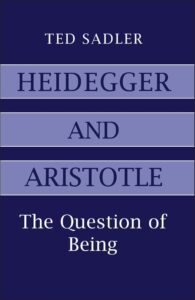
Heidegger’s critique of Western philosophy centres around his interpretation of Aristotle. Yet, hitherto, there has been no attempt to reconstruct the relation between these two thinkers, a major interpretive task for which Heidegger and Aristotle provides an initial orientation. Sadler focuses on the ‘question of being’ and shows how their respective responses to this question ramify over the whole field of their philosophical thought.
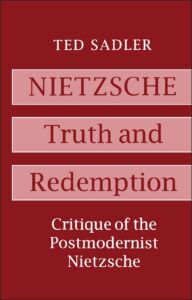
This challenging reading of Nietzsche counters the highly misleading interpretation of postmodern commentators, largely under the influence of Derrida. In this powerful critique, Sadler reconstructs Nietzsche’s relationship to Schopenhauer and Heidegger, and argues that Nietzsche was not, as the postmodernists contend, a relativist or pluralist, but that he cultivated an existential appreciation of truth.